

Forecasting, predicting the outcome of future events, is a growing use case for AI systems, but it depends on having reliable, current, and verifiable information to reason from. Mantic, an AI forecasting company, uses Wikimedia Enterprise to help ground its models in real-world knowledge. The partnership is one example of how organizations are building on top of Wikimedia project content through Wikimedia Enterprise's commercial data services.
"Forecasting is only as good as the information it's built on, which is why we're excited to partner with Mantic. Wikimedia Enterprise provides Mantic with reliable, human-curated data to ground its predictions. In turn, Mantic helps ensure that Wikimedia content is recognized as a trusted foundation for the AI systems people are increasingly relying on to make sense of the world. Partnerships like this one are part of what keeps the free knowledge ecosystem sustainable and thriving."
- Lane Becker, President of Wikimedia Enterprise
Screenshot: Mantic
How Mantic uses Wikipedia data
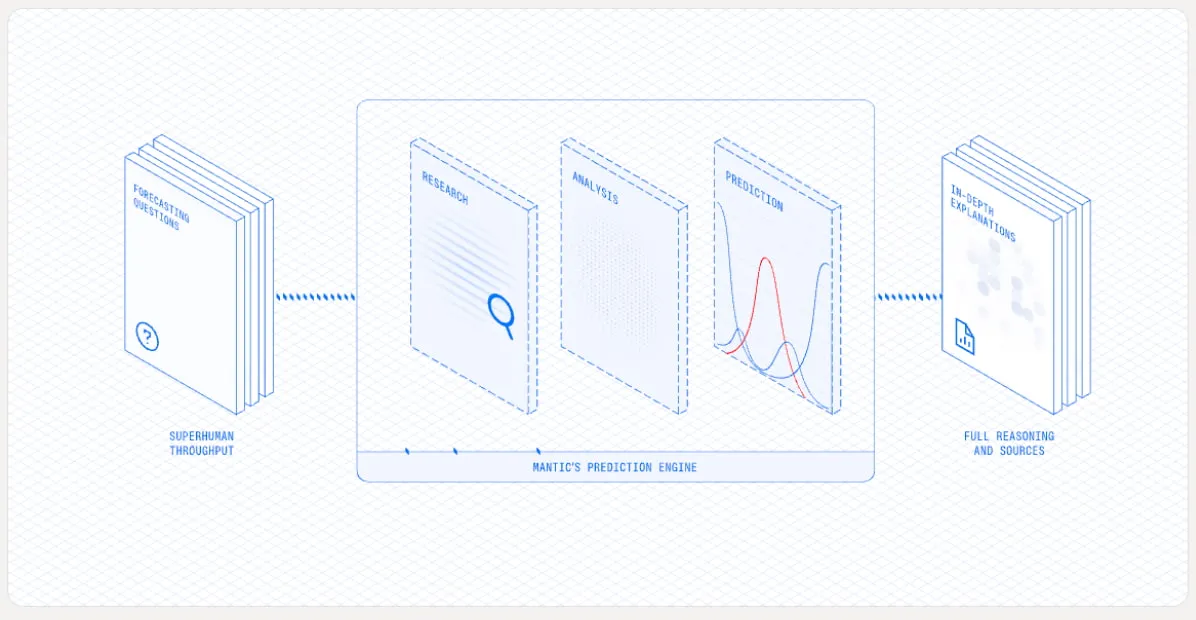
Mantic's AI agents research forecasting questions by processing large volumes of text and using it to generate predictions. The company says Wikipedia's structure, articles that are extensively cross-linked to one another, helps its models trace relationships between topics and surface context that standard RAG (Retrieval-Augmented Generation) methods can miss.
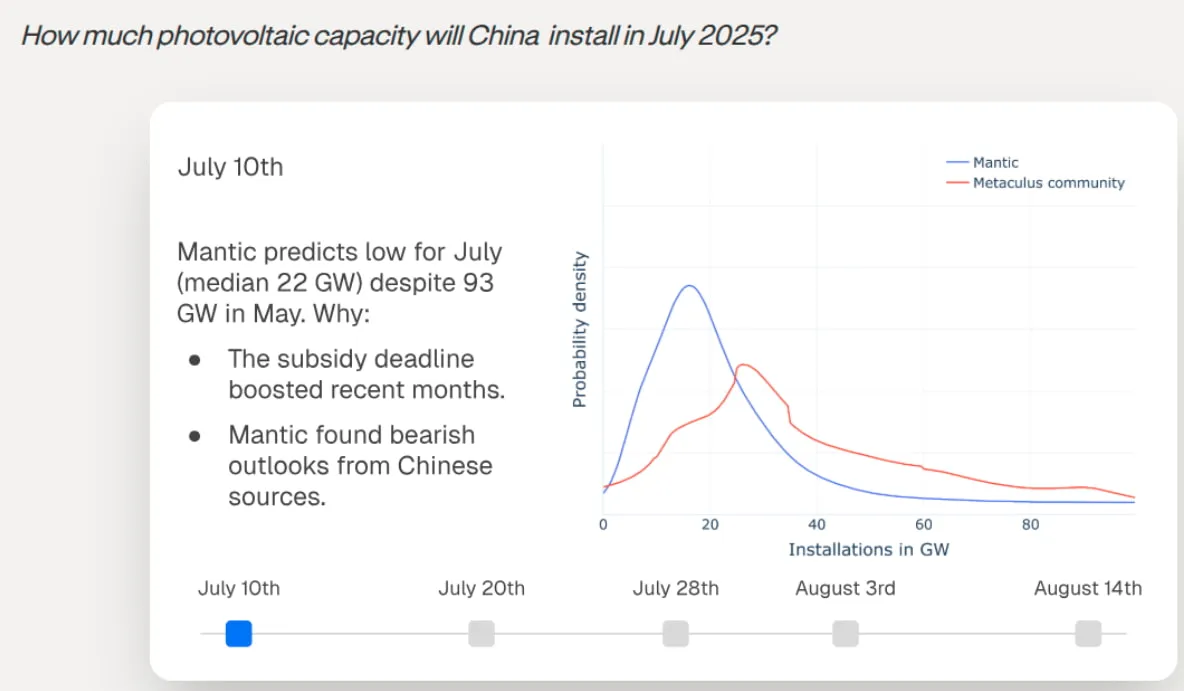
According to Mantic, Wikipedia data solves a major engineering challenge: the need for back-testing. Wikipedia's article coverage and revision history can help Mantic approximate what was publicly available at a given point in time, and use that to test its models. For instance, to check whether Mantic's models would have correctly predicted the downturn in Chinese solar panel production in 2025, Mantic can restrict its AI to only the information publicly available on Wikipedia before that date and measure how well its system would have predicted the events that followed. This method of back-testing to improve is something human forecasters, who can't forget they know something, simply can't do.
Mantic produces thousands of forecasts a day: standard API rate limits had constrained how much data it could ingest. Through Wikimedia Enterprise, the company now accesses Wikipedia and other Wikimedia data via monthly data dumps, the kind of scaled access Wikimedia Enterprise offers to organizations with substantial data needs.
Mantic's forecasting pipeline. Source: Mantic
Mantic's forecasting competition, Crucible
Beyond generating its own predictions, Mantic runs a public forecasting competition called Crucible. Mantic says its models have outperformed both crowd-sourced forecasts and human superforecasters on certain benchmarks, a claim the company highlights as a differentiator in a competitive forecasting field.
Knowing the right question to ask is a large part of delivering a good forecast. Many existing forecasting benchmarks rely on simplistic questions that don't effectively measure a model's true capabilities. To solve this, Mantic recently launched its own forecasting competition called "Crucible". In Crucible, forecasters are scored on how accurate their predictions are, while question writers are scored on how much disagreement their questions generate among forecasters: an attempt to reward well-constructed questions rather than ones with obvious answers. Mantic says this dual-scoring approach addresses a common weakness in existing forecasting benchmarks, which can rely on questions that are too simple to meaningfully test a model's capabilities.
Why this matters for Wikimedia Enterprise
Partnerships like this one are a perfect use case of what's working: as more AI systems compete to produce trustworthy, accurate outputs, demand is growing for exactly the kind of verifiable, well-sourced, human-curated knowledge that Wikimedia projects provide. That demand comes with responsibility. As part of the partnership, Mantic accesses Wikimedia content through Wikimedia Enterprise's terms of use, which include expectations around attribution. These help ensure that when Wikimedia project knowledge is reused in other systems, its origin remains visible and traceable back to the volunteers behind it.
A Mantic forecast, shown for illustration. Source: Mantic
About Mantic
Mantic is an AI forecasting company developing tools for generating probabilistic forecasts across a wide range of topics. By utilizing advanced AI agents and robust data sources, Mantic answers complex questions across a broad range of topics, making high-quality forecasting capabilities more scalable than ever before.
- Wikimedia Enterprise Team
Photo Credits
Macro of Cladonia moss, CC BY
