

Wiktionary API
Access the world's most comprehensive multilingual lexical database
Wiktionary is to dictionaries what Wikipedia is to encyclopedias: a collaborative project to describe every word in every language, free to use and free to redistribute. It holds over 49 million entries across 174 language editions, more than nine million of them in English alone, and each edition documents thousands of languages in its own.
Access Wiktionary through the Wikimedia Enterprise APIs to power Natural Language Processing, train machine translation engines, build spell-checkers and morphological analyzers, and research etymology, phonetics, and language change over time.
Detailed, standardized entries for any target language
Wiktionary is organized by target language. The English edition defines terms from over 4,500 languages, all explained in English, and the same holds for every other edition. That structure lets you cross-reference a term and its translations from any language into any other.
- Strict structure, written for humans: Wiktionary is free-text wiki markup, but entries are governed by clear layout policies and normalization rules that put the same sections in the same order on every page. That predictability is what makes parsing tractable at scale.
- Beyond definitions: an entry can carry pronunciations in IPA, etymologies, inflection and conjugation tables, synonyms and antonyms, usage quotations, spelling variants, and translations. The result is a full picture of a word's role in its language rather than a gloss.
- All languages, one platform: Wiktionary defines words from thousands of languages, including extinct, medieval, and constructed languages such as Esperanto, and explains each of them inside 170+ different language editions.
- Trusted data: like every Wikimedia project, Wiktionary holds firm standards for when a term qualifies for inclusion, for neutrality, and for blocking the accounts and reverting the edits that go outside them.
Why is Wiktionary data so useful?
At its core Wiktionary is a dictionary. What makes it different from every other dictionary is that it is open, extensible, crowdsourced, and linked to the rest of the Wikimedia projects. It is the lexical companion to Wikipedia.
Over two decades it has grown into a highly structured, multifaceted linguistic database, and an essential dataset for computational linguistics and AI development. Unlike a static print dictionary, it is a living record that captures language change as it happens.
- Usage examples and citations: entries are backed by real citations from literature, news, and historical documents, which is how a model learns how a word behaves in context rather than only what it means.
- Rapid adaptation: because it is crowdsourced, Wiktionary captures neologisms, internet slang, and technical jargon years before print dictionaries reach them.
- Morphological and grammatical data: for many languages Wiktionary provides exhaustive conjugation and declension tables, a critical resource for training on morphologically rich languages.
- Pronunciation and audio: many entries include IPA transcriptions and recordings by native speakers, which makes Wiktionary a corpus for Speech-to-Text and Text-to-Speech work as well as for text.
- Openly licensed: all Wiktionary content is licensed under CC BY-SA and the GNU Free Documentation License, so you can reuse it for any purpose, including commercially, as long as you attribute the source and share derivative work under the same license.
What data can I find in Wiktionary?
Wiktionary holds categories of data that proprietary lexical datasets usually leave out.
- Etymology and history: trace a word back through its ancestors to roots such as Proto-Indo-European, which is the raw material for studying linguistic drift and language family relationships.
- Translation matrices: a single entry for a common concept often carries a table of translations into hundreds of languages, a large and high-quality parallel dataset in one page.
- Thesaurus and semantic relations: hypernyms, hyponyms, and meronyms for building semantic graphs and recommendation systems.
- Anagrams and rhymes: dedicated sections list anagrams and rhyming words, useful for creative writing tools, accessibility apps, and word games.
- Regional variation and dialect: Wiktionary records dialectal differences such as Quebecois French or Austrian German, which is the cultural specificity localized agents and translation tools need.
- Phrasebooks: collections that let you express a concept in any language, organized by topic.
- Linguistic statistics: frequency lists and other statistics give a quantitative view of how a language is used and how it relates to its neighbors.
- Appendices: hundreds of pages on niche topics in linguistics, phonetics, slang, and culture, from Balkanisms to Quenya to false friends and the zodiac in every language.
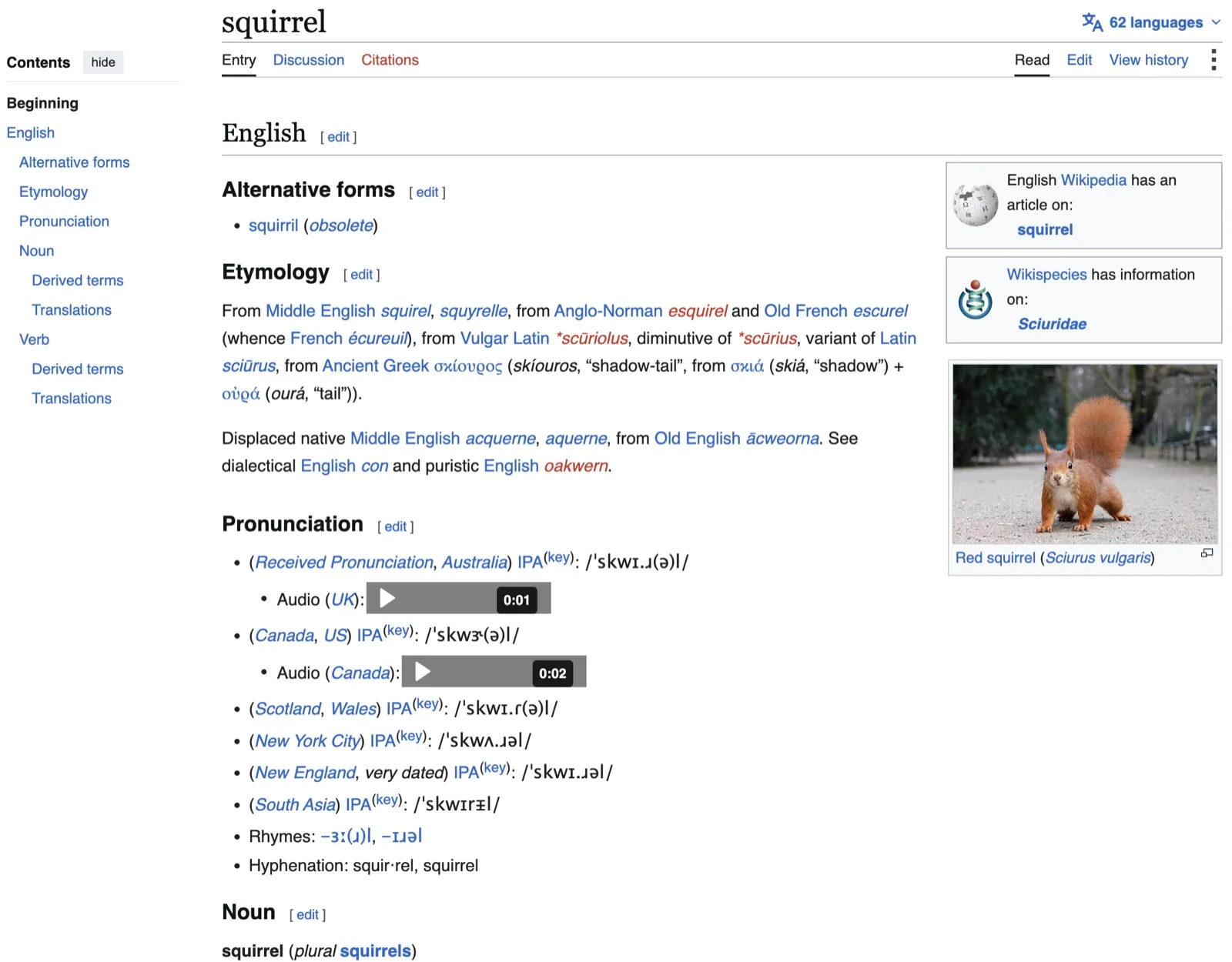
Source: squirrel on English Wiktionary
Use Wiktionary to decode the building blocks of human communication. Whether you are building a translation tool for a rare dialect or grammar correction for a global product, it is the foundational data.
How to access Wiktionary data
Retrieve a complete language edition for offline processing with the Snapshot API, or query specific terms with the On-demand API. Both are part of the Wikimedia Enterprise APIs, both return the same consistent JSON envelope, and one access token covers every Wiktionary edition alongside every other Wikimedia project.
Example call to download the full French Wiktionary snapshot:
curl -L 'https://api.enterprise.wikimedia.com/v2/snapshots/frwiktionary_namespace_0/download' \ -H 'Authorization: Bearer ACCESS_TOKEN'Example call to get the entry for the word "squirrel" from English Wiktionary:
curl -L 'https://api.enterprise.wikimedia.com/v2/articles/squirrel' \ -H 'Content-Type: application/json' \ -H 'Authorization: Bearer ACCESS_TOKEN' \ -d '{"filters":[{"field":"is_part_of.identifier","value":"enwiktionary"}]}'Entry titles are case sensitive, and that matters more on Wiktionary than anywhere else. Most wikis capitalize the first letter of a title for you; Wiktionary does not, because case is part of the word. polish and Polish are two separate entries with unrelated meanings, and squirrel resolves while Squirrel does not exist at all.
Getting a 403: Forbidden error? Sign up for a free Wikimedia Enterprise account and use the Login endpoint to get an access token.
What comes back in a Wiktionary response
A Wiktionary entry arrives in the same JSON envelope as any other Wikimedia page, so one parser covers all 174 editions:
article_body.wikitextandarticle_body.htmlhold the entry, in source markup and rendered form.templateslists the templates the entry uses, which is how the inflection tables, IPA blocks, and translation boxes are generated.categoriescarries the language, part of speech, and topic classifications the community maintains.versionrecords the revision, its editor, and its size, andlicensestates the terms the entry ships under.
article_body.wikitext is the field to reach for when extracting lexical structure. Wiktionary's layout policy puts language, part of speech, pronunciation, etymology, and translations in a predictable order, and the templates that render them are listed separately, so you can key a parser off the markup rather than off rendered HTML. The Data Dictionary documents every field, and the API reference has the full schema alongside a live example response.
Frequently Asked Questions
Is there a Wiktionary API?
Yes. Wiktionary data is available through the Wikimedia Enterprise APIs, built and run by the Wikimedia Foundation. You get every entry with its full wikitext and HTML, its revision history metadata, its categories and templates, and its license, in one consistent JSON schema shared with every other Wikimedia project.
Does the API return parsed definitions and IPA as separate fields?
Not today. Wiktionary entries are returned as HTML and wikitext, so pronunciation, etymology, and inflection tables arrive as marked-up sections rather than as discrete fields. What the API removes is everything around that: authentication once, bulk delivery, consistent metadata, and no page-by-page scraping. Our pre-parsed Structured Contents endpoints currently cover Wikipedia editions, not Wiktionary.
Is the Wiktionary API free?
Yes. A free Wikimedia Enterprise account includes snapshot downloads and a monthly allowance of On-demand requests, with no credit card. Paid accounts add higher volume, hourly and real-time updates, and production support. See pricing for current limits.
How do I download all of Wiktionary?
Use the Snapshot API. Each edition is published as a bundle named on the pattern enwiktionary_namespace_0 and refreshed on a schedule, with larger bundles split into chunks you can pull in parallel. Identifiers covers how a snapshot name is composed.
How is this different from scraping the MediaWiki API?
The public MediaWiki API is per-request and rate limited, which makes a full-corpus pull slow and fragile. Wikimedia Enterprise is built for the bulk case: a whole language edition arrives as one download, On-demand requests come with a service level, and the response schema is identical across all 170+ Wiktionary editions and every other project, so one parser covers all of them.
Which languages does Wiktionary cover?
Wiktionary runs in over 170 language editions, and each edition documents far more languages than its own. The English edition alone defines terms from more than 4,500 languages. Use the Metadata endpoints to list the exact project and language codes available to your account.
Get Started
Access Wiktionary, Wikipedia, and the rest of the Wikimedia project data through one unified API with consistent JSON output. Unlock the full complexity of global language on enterprise-grade infrastructure, and get started with free instant access today.