

Wikiquote API
Access the world's largest compendium of sourced quotations
Wikiquote is the Wikimedia sister project dedicated to collecting quotations from notable people and from works of art. It runs in 77 language editions holding over 380,000 quotation pages, close to 69,000 of them in English, and each page collects many quotes rather than one. It is the only free online compendium of its kind that sets out to be both accurate and comprehensive.
Access Wikiquote through the Wikimedia Enterprise APIs to enrich conversational AI, build creative writing assistants, power quote-of-the-day features, and research sentiment, rhetoric, and attribution at scale.
Why is Wikiquote data so useful?
Wikiquote does not accept every submission. It is a reference work that puts provenance and accuracy first, under the same Neutral Point of View and verifiability policies that make Wikipedia work.
- Sourced and attributed: most quote sites recycle unsourced internet folklore. Wikiquote editors prioritize the original appearance of a quotation and cite the book, speech, or interview it came from, which is what lets a model tell a genuine remark from a misattribution.
- Built to expose misinformation: Wikiquote maintains dedicated sections for quotes that are disputed (unverifiable but possibly real) and quotes that are misattributed (traced to someone else). That is a labeled dataset of famous false attributions, which is hard to find anywhere else.
- Contextual metadata: quotes are rarely listed in isolation. They sit under a topic, a speaker, or a work, and usually carry the scene, chapter, or occasion they came from.
- Multilingual parallelism: many famous quotations appear in their original language alongside a professional translation, a small but unusually high-context parallel corpus.
- Comprehensive by design: Wikiquote seeks quotations from a wide range of people and works, past and present, rather than only the handful that circulate most, so underrepresented voices are also on the record.
- Notability applies: as on Wikipedia, a quotation has to clear a notability bar. It qualifies through lasting relevance, through appearing in a notable work, or through being said by a notable person.
What data can I find in Wikiquote?
- Deep categorization: find quotes by author (Frederick Douglass), by work (The Meaning of Relativity), by theme (the Gender category), by period (the 19th century), or by almost any other cut. One article is a curated collection, not a single line.
- Quotes from every kind of creative work: not only historical figures but films, television, plays, poems, and songs, including pages for recent releases.
- The misattributed and disputed sections: separate, explicitly labeled blocks for quotations that cannot be verified and for quotations traced to the wrong person. Useful as training and evaluation data for fact-checking systems.
- Proverbs and folklore: extensive collections of proverbs from hundreds of cultures, frequently with both a literal translation and a cultural equivalent. There is a page devoted to Zen proverbs alone, available in five languages.
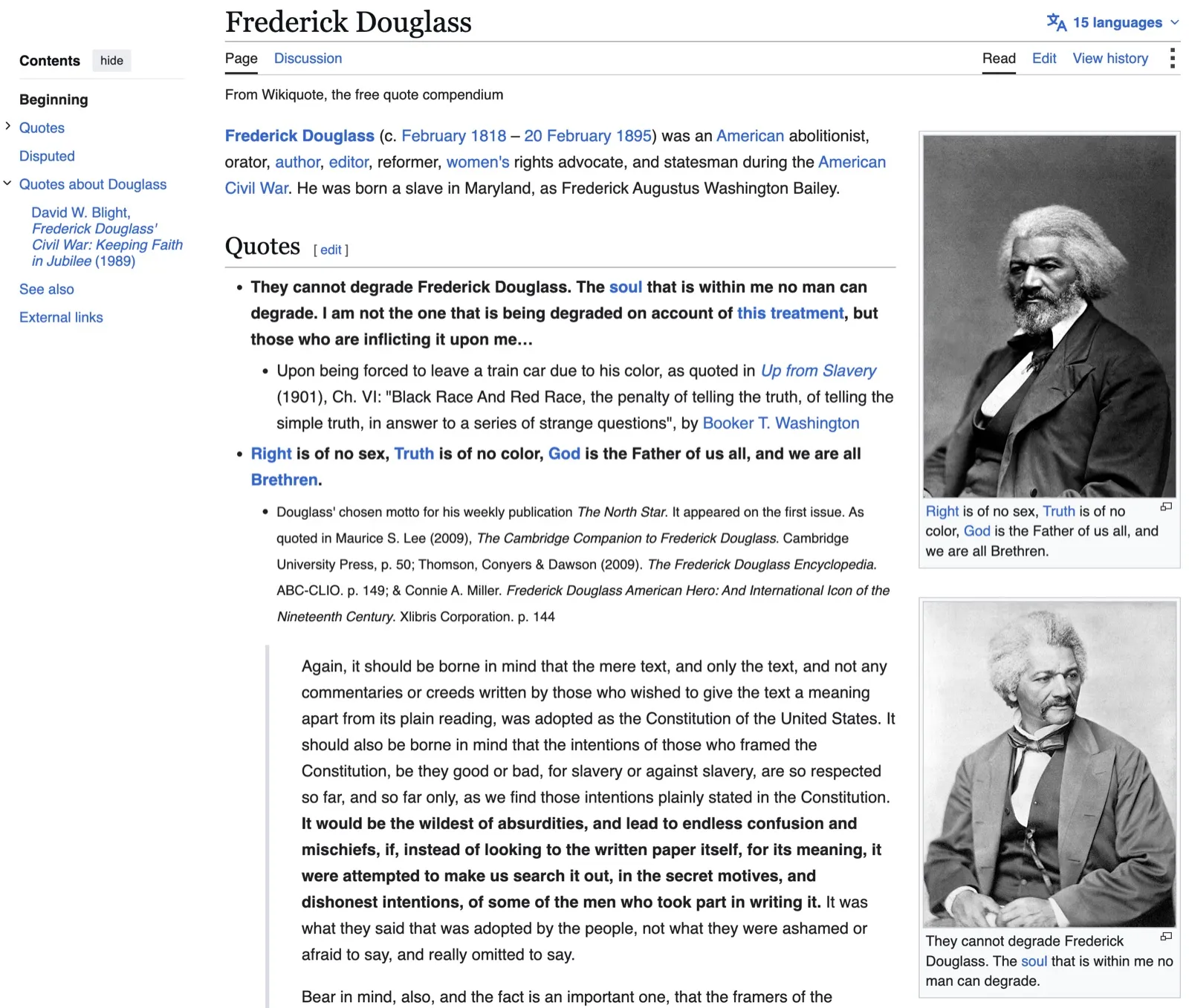
Use Wikiquote to retrieve the most consequential snippets of language from history to the present, across languages and cultures, with the sourcing attached.
How is Wikiquote different from a quotes API?
Most quotation APIs are one of two things: a fixed list of a few thousand popular lines, or a scraper pointed at Wikiquote. The first is small and rarely sourced. The second inherits Wikiquote's data without its licensing, its update cadence, or any guarantee it will still be running next year.
Wikimedia Enterprise is the direct route. You get the whole project rather than a curated slice, in every language it publishes in, under an explicit open license, refreshed on a schedule, from the Wikimedia Foundation itself.
How to access Wikiquote data
Retrieve a full language edition with the Snapshot API, or query a specific author or work with the On-demand API. Both are part of the Wikimedia Enterprise API suite, and one access token covers every Wikiquote edition alongside every other Wikimedia project.
Example call to download the full Italian Wikiquote snapshot:
curl -L 'https://api.enterprise.wikimedia.com/v2/snapshots/itwikiquote_namespace_0/download' \ -H 'Authorization: Bearer ACCESS_TOKEN'Example call to get the Albert Einstein page from English Wikiquote, sourced quotes and misattributions together:
curl -L 'https://api.enterprise.wikimedia.com/v2/articles/Albert_Einstein' \ -H 'Content-Type: application/json' \ -H 'Authorization: Bearer ACCESS_TOKEN' \ -d '{"filters":[{"field":"is_part_of.identifier","value":"enwikiquote"}]}'Getting a 403: Forbidden error? Sign up for a free Wikimedia Enterprise account and use the Login endpoint to get an access token.
What comes back in a Wikiquote response
A Wikiquote page arrives in the same JSON envelope as any other Wikimedia page, so one parser covers all 77 editions:
article_body.wikitextandarticle_body.htmlhold the page, in source markup and rendered form.categoriesis the topic index: author, work, theme, and period all surface here.main_entitylinks the subject to its Wikidata item, which is how you match a speaker across languages.versionrecords the revision, its editor, and its size, andlicensestates the terms the page ships under.
The section structure is where the value sits. Wikiquote pages put sourced quotations, Disputed, and Misattributed in separate headed sections, so a parser reading article_body.wikitext can keep the label attached to each quotation instead of flattening a page into an undifferentiated list. The Data Dictionary documents every field, and the API reference has the full schema alongside a live example response.
Frequently Asked Questions
Is there a Wikiquote API?
Yes. Wikiquote data is available through the Wikimedia Enterprise APIs, built and run by the Wikimedia Foundation. Every page comes back with its full wikitext and HTML, its revision metadata, its categories, and its license, in the same JSON schema used for every other Wikimedia project.
Is the Wikiquote API free?
Yes. A free Wikimedia Enterprise account includes snapshot downloads and a monthly allowance of On-demand requests, with no credit card. Paid accounts add higher volume, hourly and real-time updates, and production support. See pricing for current limits.
Can I use Wikiquote data commercially?
Yes, within the license. Wikiquote is published under CC BY-SA 4.0 and the GNU Free Documentation License, which permit commercial use as long as attribution is preserved and derivative works carry the same license. The license block travels inside every API response. Individual quotations may also carry their own copyright in their source work, so quoting at length is a separate question from the wiki's license.
Does the API return each quote as its own object?
Not today. A Wikiquote page is returned as HTML and wikitext, so individual quotations arrive inside the page body rather than as discrete records. The headed sections and citation templates make them straightforward to extract, and the templates array tells you which ones a page uses.
How do I get a quote of the day?
Each edition maintains its own quote-of-the-day pages. Request them by name through the On-demand API with an is_part_of.identifier filter for the edition you want, or subscribe to the Realtime API to receive them as they change.
How do I find quotes about a specific topic?
Wikiquote's own categories are the index. Every page lists its categories in the API response, so you can pull a snapshot once and build topic subsets locally, or filter On-demand requests down to the edition and page you need. Filtering covers the available fields.
Get Started
Access Wikiquote, Wikipedia, and the rest of the Wikimedia project data through one unified API with consistent JSON output. Unlock the power of human perspective on enterprise-grade infrastructure, and get started with free instant access today.