

Wikiversity API
Open learning resources, original research, and course material
Wikiversity is the Wikimedia sister project dedicated to learning. It hosts course modules, lesson plans, study guides, learning activities, and original research for every level of education, from pre-school through university. Wikiversity grew out of Wikibooks in 2006 and now runs in 17 language editions holding around 175,000 pages, with English and German the largest at roughly 55,000 each.
Access Wikiversity through the Wikimedia Enterprise APIs to train models on pedagogical reasoning, build tutoring agents that teach a topic rather than summarize it, generate curriculum and study material, and ground research tools in openly licensed scholarship.
Learning material written by teachers and students
Wikiversity is built for active instruction. Volunteers, educators, and students write the course material, design the learning activities, and maintain the site's policies, the same way every other Wikimedia project is written and curated by people. Content is dual-licensed under Creative Commons Attribution-ShareAlike 4.0 and the GNU Free Documentation License.
- Three kinds of content, one project: learning materials are the open educational resources, the syllabi, lecture notes, slides, study guides, and exams. Learning communities are the self-directed spaces where students and teachers work through a subject together. Scholarly research is original, collaborative work published on the wiki itself.
- Original research lives here: Wikiversity is the Wikimedia project that hosts original scholarship, which makes it a distinct corpus from encyclopedic reference content. Three peer-reviewed WikiJournals sit on the platform, covering medicine, science, and the humanities, publishing in a stable, indexed, citable form with no author fees.
- Written for Wikiversity: its articles are composed on the platform or adapted from open educational resources, and its policies keep the text human-written rather than machine-generated. That gives you a clean instructional corpus rather than a rewrite of material you already hold.
- Rich media throughout: Wikiversity leans on diagrams, schematics, and photographs from Wikimedia Commons to carry the harder concepts, so the visuals that explain a lesson come with it.
Build tutoring systems and context-aware EdTech tools
Wikiversity sits inside the wider Wikimedia knowledge graph, so a course module connects outward to definitions, source texts, and structured facts.
- Layer it with the sister projects: combine Wikiversity with Wikipedia for reference context, Wikibooks for structured textbooks, and Wiktionary for terminology, and a learner gets a definition, a deep dive, and a lesson from one pipeline.
- Follow the entity, not the string: Wikiversity pages link to Wikidata items, which is how a subject stays the same subject across 17 languages and across every project that covers it.
- Model the progression: portals index departments, resources break into units, and subpages carry the sequence in the page name itself, so a course reads as an ordered curriculum rather than a bag of documents.
What data can I find in Wikiversity?
A Wikiversity page is usually one unit of something larger: a course, a portal, or a research project. Portals act as the departmental index and link out to the resources beneath them. The subject range covers physical sciences, life sciences, humanities, professional studies, and computing, at levels from pre-school activities up to graduate seminars.
A Wikiversity resource generally holds:
- Learning objectives: what the learner needs going in and what they should be able to do coming out.
- Core learning content: the body of the lesson, broken into headed subsections that map to lectures, modules, or steps in an argument.
- Learning activities: assignments, research tasks, discussion prompts, and review questions, which is the material that trains and evaluates automated assessment.
- References and further resources: citations and onward links, both to external sources and to other wikis.
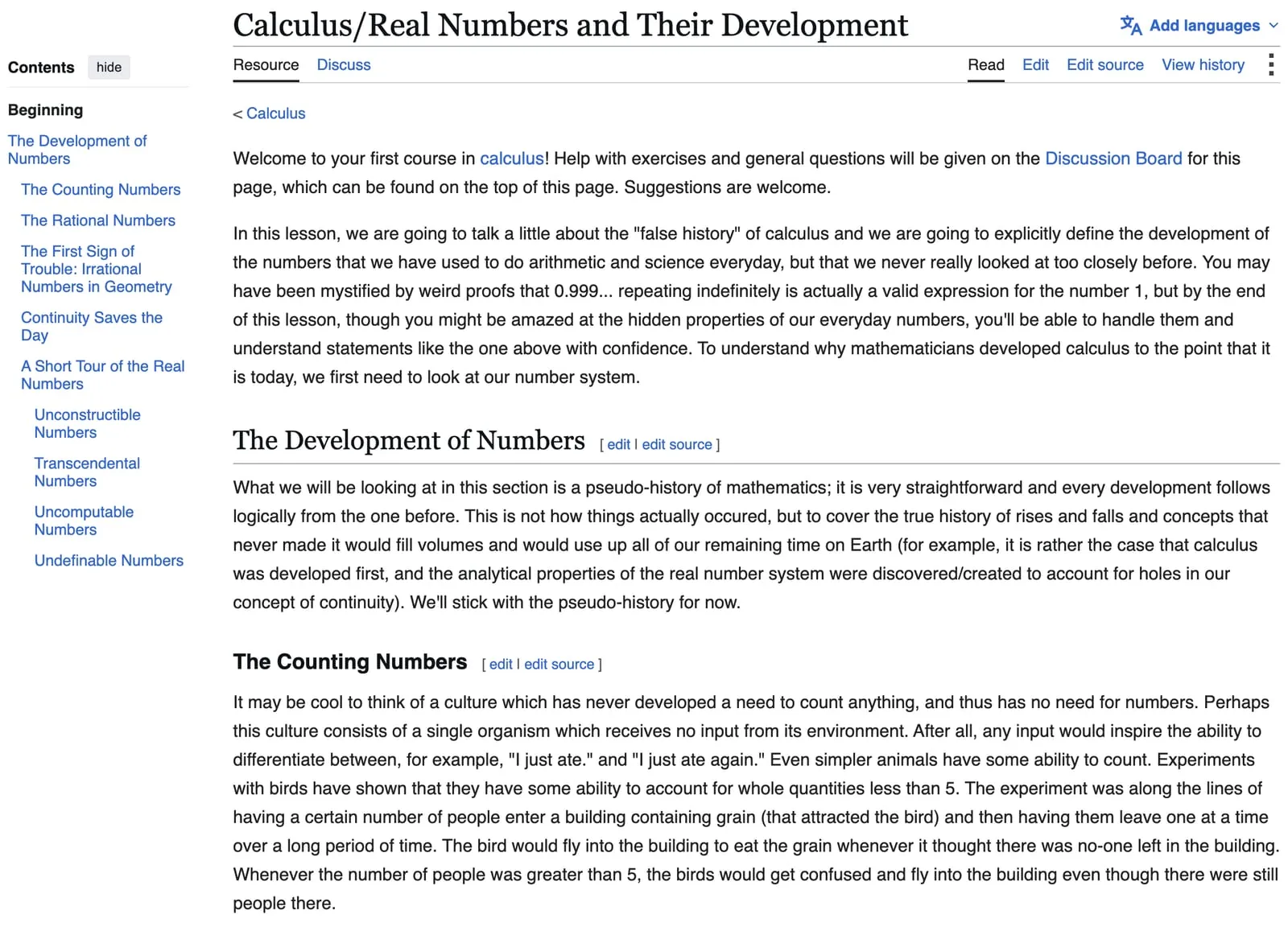
Source: Calculus/Real Numbers and Their Development on English Wikiversity
Where to find other instructional data
Several Wikimedia projects carry teaching material, each in its own shape. Wikibooks is the library of instructional textbooks, manuals, and how-to guides, organized into chapters and learning modules, and it overlaps with Wikiversity by design: Wikiversity teaches a subject collaboratively, Wikibooks writes the book on it.
Published works out of copyright, including historical textbooks and primary documents, are held by Wikisource, a library of free source texts and translations.
How to access Wikiversity data
Retrieve a full language edition with the Snapshot API, or request a single resource with the On-demand API. Both are part of the Wikimedia Enterprise API suite, and one access token covers every Wikiversity edition alongside every other Wikimedia project.
Example call to download the full English Wikiversity snapshot:
curl -L 'https://api.enterprise.wikimedia.com/v2/snapshots/enwikiversity_namespace_0/download' \ -H 'Authorization: Bearer ACCESS_TOKEN'Example call to get one calculus lesson from English Wikiversity:
curl -L 'https://api.enterprise.wikimedia.com/v2/articles/Calculus/Real_Numbers_and_Their_Development' \ -H 'Content-Type: application/json' \ -H 'Authorization: Bearer ACCESS_TOKEN' \ -d '{"filters":[{"field":"is_part_of.identifier","value":"enwikiversity"}]}'Getting a 403: Forbidden error? Sign up for a free Wikimedia Enterprise account and use the Login endpoint to get an access token.
What comes back in a Wikiversity response
A Wikiversity page arrives in the same JSON envelope as any other Wikimedia page, so one parser covers all 17 editions:
article_body.wikitextandarticle_body.htmlhold the resource, in source markup and rendered form.namecarries the course path, soCalculus/Real_Numbers_and_Their_Developmenttells you which course a lesson belongs to before you open it.categoriesis the subject index: department, discipline, and level all surface here.main_entitylinks the topic to its Wikidata item, which is how a lesson on limits matches the article on limits.versionrecords the revision, its editor, and its size, andlicensestates the terms the page ships under.
The heading structure is where the teaching sits. Objectives, lesson body, activities, and references arrive as headed sections, so a parser reading article_body.wikitext can keep a review question attached to the material it tests instead of flattening a course into plain text. The Data Dictionary documents every field, and the API reference has the full schema alongside a live example response.
Frequently Asked Questions
Is there a Wikiversity API?
Yes. Wikiversity data is available through the Wikimedia Enterprise APIs, built and run by the Wikimedia Foundation. Every page comes back with its full wikitext and HTML, its revision metadata, its categories, and its license, in the same JSON schema used for every other Wikimedia project.
Is the Wikiversity API free?
Yes. A free Wikimedia Enterprise account includes snapshot downloads and a monthly allowance of On-demand requests, with no credit card. Paid accounts add higher volume, hourly and real-time updates, and production support. See pricing for current limits.
How do I download all of Wikiversity?
Use the Snapshot API to pull a complete edition as a single dataset, delivered in chunks for the larger languages. Request enwikiversity_namespace_0 for English, and the Metadata endpoints list every Wikiversity edition you can name.
What license is Wikiversity data?
Wikiversity is dual-licensed under CC BY-SA 4.0 and the GNU Free Documentation License. Both permit commercial and non-commercial use, including redistribution, adaptation, and inclusion in academic research, as long as attribution is preserved and derivative works carry the same license. The license block travels inside every API response.
How is Wikiversity different from Wikipedia or Wikibooks?
Wikipedia is encyclopedic reference. Wikibooks is the textbook library, organized into chapters and modules. Wikiversity is the classroom: course material, learning activities, study groups, and original research. For AI training, Wikiversity supplies pedagogical structure and scholarly work that complement Wikibooks' step-by-step instruction and Wikipedia's descriptive coverage.
What subjects does Wikiversity cover?
Physical sciences, life sciences, humanities, professional studies, and computing, with resources running from pre-school activities to university-level courses. Many subjects also carry active research portals maintained by the community.
Does Wikiversity grant degrees?
No. Wikiversity is an open platform for lifelong learning, study groups, and open research, and it awards no degrees, diplomas, or course credits. That is what keeps its material fully open, modular, and reusable in any learning tool you build.
What are the WikiJournals?
Three peer-reviewed, diamond open-access journals hosted on Wikiversity, covering medicine, science, and the humanities. Articles are reviewed by named academics and published in stable, citable form, which gives you peer-reviewed scholarship inside the same API response format as the rest of the project.
Get Started
Access Wikiversity, Wikipedia, and the rest of the Wikimedia project data through one unified API with consistent JSON output. Put openly licensed, human-taught knowledge behind your learning tools on enterprise-grade infrastructure, and get started with free instant access today.