

Wikidata’s structured knowledge is now available through Wikimedia Enterprise. These new Beta Wikidata API endpoints are part of the On-demand and Realtime APIs, giving you access to the world’s largest open knowledge graph through a high-availability, production-scale interface built for commercial volume, using the same API token you already use for Wikipedia, Wiktionary, Wikivoyage, and more.
Over the past two years, Wikimedia Deutschland and Wikimedia Enterprise have closely collaborated to explore how Wikidata’s structured data can be included in Wikimedia Enterprise APIs in a way that reflects our shared mission and responsibilities.
If you’re already using Wikimedia Enterprise to retrieve Wikipedia articles, you’re closer than you think. Every article response already includes a QID field that these new endpoints can act on directly. All with the same token, no additional setup required. To learn more about how Wikimedia Enterprise and Wikimedia Deutschland are jointly working to improve access to free structured knowledge, see WMDE’s statement.
In this article:
- New Wikidata Endpoints
- How to use them
- How to access them
- Why Wikidata?
- What is Wikidata?
- What to do with them
- Get Started
Reading time:
The New Wikidata API Endpoints
We’ve designed our new Beta Wikidata endpoints to fit directly into your development workflow, whether you need a single fact or a real-time stream of global updates. The integration starts with data you’re already receiving: every Wikipedia article response from Wikimedia Enterprise already includes an entity_id field containing the QID for that article’s subject. Pass that QID to /v2/wikidata/items/{QID} to retrieve the full entity record, including entity.sitelinks. The entity sitelinks map that topic to corresponding article titles across every Wikipedia language edition. Until now, retrieving the same topic across language editions meant already knowing the exact article title in each language. With Wikidata sitelinks, a single QID returns the correct article title for every available language edition, so you can retrieve exactly the article you need without any manual title research.
Our endpoints also include the English label for every Item and Property identifier in the payload, and you can extract all of the other language labels using the Labels List endpoint. This way, your knowledge base is always populated with English human-readable labels, and you can use the List Labels endpoint whenever you want to expand multilingually.
| Endpoint | Primary Purpose | Key Identifiers |
|---|---|---|
| On-demand endpoints | ||
| Item Lookup | Get all data and metadata of the last revision of an item: revision info, labels, descriptions, statements, sitelinks. | Q-number (e.g., Q42: Douglas Adams) |
| Property Lookup | Retrieve all information about a property, a single category that connects statements. | P-number (e.g., P106: occupation) |
| Labels List | Translate machine IDs into human-readable text in any language. | Q- or P-numbers |
| Realtime endpoints | ||
| Realtime Stream | A “firehose” of every update, deletion, and change in Wikidata as it happens. Every Realtime edit event also includes the full entity data payload, so you can build your internal knowledge base as changes happen in real-time. | N/A |
How to use Wikidata API endpoints
Use the Item Lookup endpoint to get all metadata and statements about the English computer scientist Tim Berners-Lee (Q80):
curl -L "https://api.enterprise.wikimedia.com/v2/wikidata/items/Q80" -H "Authorization: Bearer ACCESS_TOKEN"Use the Property Lookup endpoint to get all information about the property ‘architect’ (P84), the property used to connect a building or other architectural object with the person or architectural firm responsible for designing it:
curl -L "https://api.enterprise.wikimedia.com/v2/wikidata/properties/P84" -H "Authorization: Bearer ACCESS_TOKEN"With the Labels List endpoint, you can retrieve all of the multilingual human-readable labels for the country of Belgium (Q31):
curl -L "https://api.enterprise.wikimedia.com/v2/wikidata/labels/Q31" -H "Authorization: Bearer ACCESS_TOKEN"To stream every edit to Wikidata in real time (available on paid plans), connect to the Realtime Stream:
curl -L "https://realtime.enterprise.wikimedia.com/v2/wikidata" -H "Authorization: Bearer ACCESS_TOKEN"How to Access the Wikimedia Enterprise Wikidata APIs
Wikidata is now available through the Wikimedia Enterprise On-demand and Realtime APIs. Free accounts have access to On-demand endpoints immediately. Don’t have an account yet? Sign up for free. Wikidata snapshots are not yet available through the Snapshot API. We’ll announce when that changes.
For higher volume needs or Realtime API access, contact our sales team.
Why Wikidata?
To get the most out of these endpoints, it helps to understand what makes Wikidata’s data model uniquely powerful. Wikipedia is the world’s most comprehensive encyclopedia, and its vast wealth of information is primarily written in formats that are easy for humans to digest when they visit a Wikipedia article. But what if you need that knowledge in a format your machine learning models, search engines, or knowledge bases can actually digest?
That’s what Wikidata is for: it connects the information from different Wikimedia projects in a machine-readable knowledge base. It provides the structure you need to leverage the world’s knowledge for machine learning, research, training models, and more.
- Universal Identifier System: Every item has a unique Q-number (like Q42 for Douglas Adams). The same is true for Properties, which connect items together using a P-number (like P31 for ‘instance of’). A statement such as ‘Douglas Adams is a human’ can be translated into the machine-readable Wikidata statement Q42 → P31 → Q5. These universal Linked Open Data URI identifiers make up the largest online knowledge graph and connect different other open-source knowledge graphs together.
- Multilingual by Design: Wikidata is language-agnostic. A single Q-number represents the same concept globally, with labels and descriptions available in hundreds of languages.
- Openly Licensed: All data is available under a CC0 waiver. Use it for commercial applications, AI training, or RAG systems.
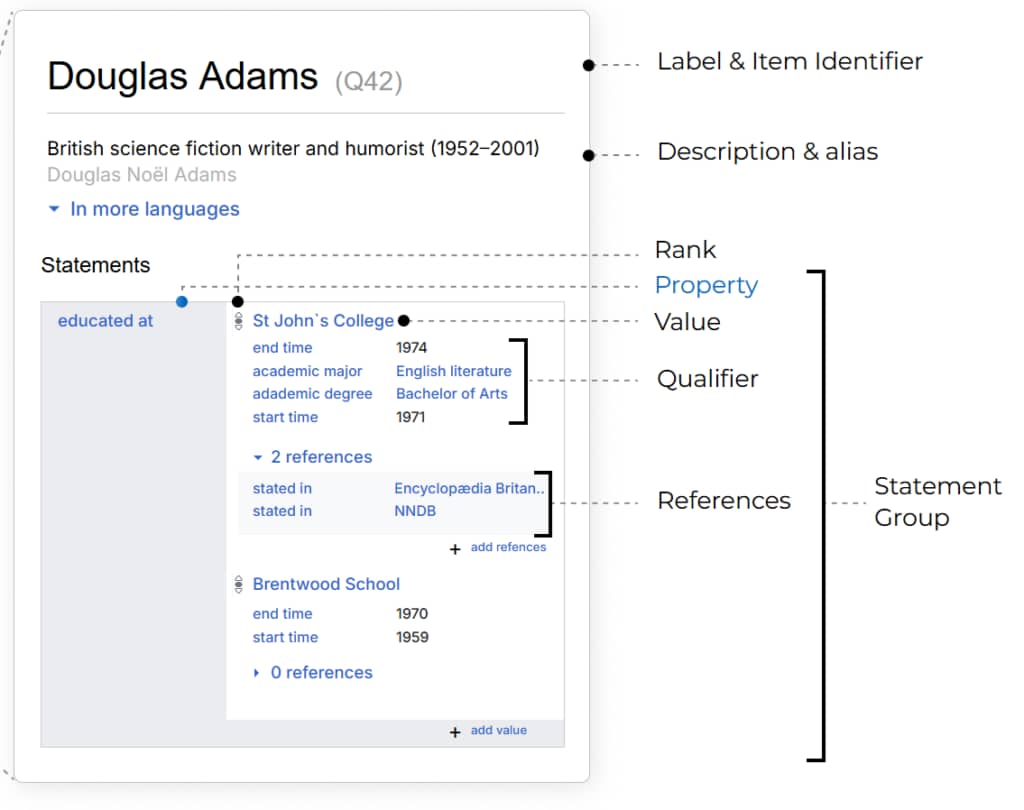
- Verifiable: Unlike other data sources that you need to fact-check yourself, statements in Wikidata are backed by verifiable references, qualifiers for additional context, and a public edit history.
- No parsing needed: The graph-based Linked Open Data nature of Wikidata means you don’t need to parse messy HTML, wikitext, or other human-written text. Your algorithms immediately understand Wikidata, gaining rich context by traversing along its graph of knowledge.
What is Wikidata?
Wikidata is the central knowledge base for the structured data of Wikimedia’s projects: Wikipedia, Wikivoyage, Wiktionary, and more. It connects data from disparate Wikimedia projects and languages, as well as hundreds of external databases and knowledge bases, through their identifiers. In this way, Wikidata is a hub of linked knowledge. It currently contains over 120 million items, structured as Linked Open Data.
Unlike a standard article, Wikidata consists of Items, Properties, and Values. This creates a “triplestore”: a database that stores facts as triplets:
Subject → Predicate → Object
Marie Curie→ Occupation→ Physicist
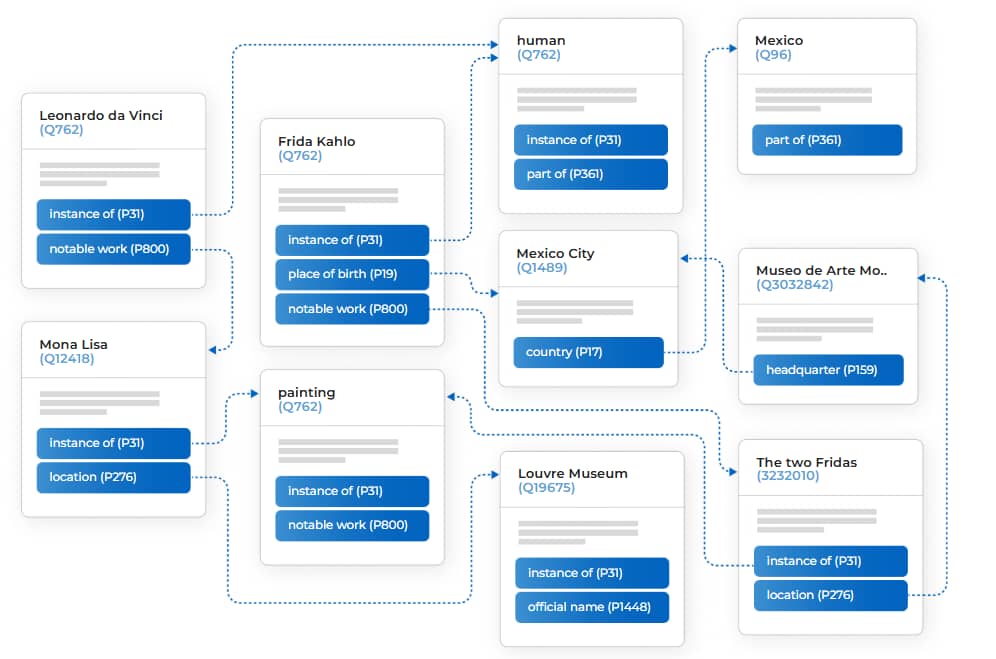
Each of these triples is a statement of some kind of fact or relationship, and each element of those statements is not a human-readable string but a machine-readable Linked Open Data URI. This makes Wikidata a graph that is perfectly suited for machines and algorithms to understand and learn from. Just like other Wikimedia projects, Wikidata is freely licensed, collaborative and maintained by volunteer editors, multilingual, and made for anyone and everyone.
What can you do with Wikidata?
- Entity Linking and Disambiguation: Since Wikidata is language agnostic and uses unique identifiers per item, it is a powerful tool to link entities together and disambiguate data from other sources.
- Categorisation: Use Wikidata’s most-used properties, such as ‘instance of‘, to quickly find out the nature of an entity: is this about a person, event, animal, object, or something else? Wikidata’s hierarchical statement structure allows implementing logic to display specific statements for specific categories: the year an event occurred, the birth and death dates of a person, the Latin name of an animal, etc.
- Extensive Authority Control: The external identifiers linked from Wikidata can be used to enrich existing knowledge bases and make them multilingual. Connect Wikidata to any existing Linked Open Data identifiers from VIAF, AAT, GND, ISNI, Library of Congress, WorldCat, and more.
- Leverage the structured data used by other Wikimedia projects: Wikidata is the structured data glue that connects many other Wikimedia projects. Many information boxes (aka infoboxes) on Wikipedia are built and maintained using Wikidata. Every Wikidata item has sitelinks that associate it with the Wikipedia page in all available languages, as well as that item on other Wikimedia project sites such as Wikivoyage, Wikisource, and more.
- Maintain Flexible and Rich Taxonomies: Combine and cross-reference existing taxonomies, including leading life sciences taxonomies. Because of Wikidata’s unique graph-based nature, its interlinked items create an emerging hierarchical and networked taxonomy that changes with every update, reflecting the changes in society at large.
- Keep Biographies and Events Always Up To Date: Wikidata has extensive information about living and historical people and events, connected to existing biographical and historical disambiguation databases such as VIAF.
Get Started
Wikidata’s addition to the Wikimedia Enterprise API suite reflects two years of collaboration between Wikimedia Enterprise and Wikimedia Deutschland. These Beta endpoints are the first step. As the integration matures, we’ll continue to announce new capabilities here. We warmly welcome any feedback you may have, either through the Meta-wiki talk page or your customer success representative.
Ready to start building? Sign up for a free account or contact our sales team to discuss your use case.
If you’re a part of the open knowledge community:
- Wikimedia Cloud Services account holders can access paid account features of Wikimedia Enterprise for free.
- Community members with mission-aligned use cases may also qualify for exceptional access.
— The Wikimedia Enterprise Team
Photo Credits
Wikidata logo using images, by Sven Manguard, CC BY-SA 3.0, via Wikimedia Commons